What Your Tongue Can Tell You About Your Health in Ayurveda
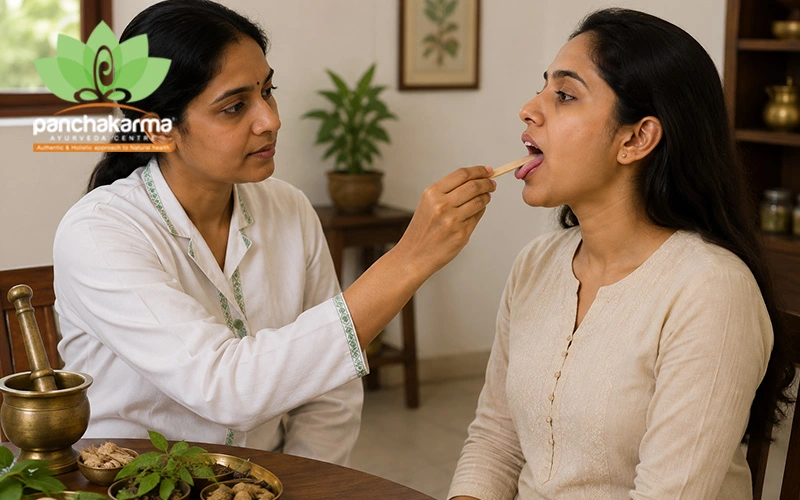
Have you ever looked at your tongue in the morning and noticed a white coating, unusual redness, cracks, swelling, or changes in texture? While these signs may seem insignificant, Ayurveda considers the tongue an important window into digestion, metabolism, and overall balance. In Ayurveda, tongue examination is known as Jihva Pariksha and forms part of Ashtasthana Pariksha, the traditional eightfold examination. Practitioners observe the tongue along with other factors such as pulse, eyes, skin, appetite, bowel habits, lifestyle, and constitution rather than interpreting one tongue characteristic on its own.
The tongue can therefore provide useful clues about Agni (digestive fire), Ama (undigested metabolic residue), and the balance of Vata, Pitta, and Kapha. But what exactly can your tongue tell you? Let’s explore the Ayurvedic perspective.
Why Does Ayurveda Examine the Tongue?
Ayurveda views digestion as central to maintaining good health. When digestion and metabolism are functioning well, the body can process food and nourish its tissues efficiently. When digestion becomes disturbed, Ayurveda associates this with the development of Ama and imbalance.
The tongue is considered particularly useful because changes in its color, coating, moisture, shape, texture, cracks, and markings may accompany changes in digestion and doshic balance.
Importantly, tongue observation is not intended to replace medical diagnosis. A tongue finding should be considered alongside symptoms, health history, lifestyle, and a professional assessment.
1. Tongue Coating May Reflect Digestive Activity
One of the first things an Ayurvedic practitioner observes is the coating on the tongue.
A thin, light coating can be a normal finding. However, a persistent or unusually thick coating may be viewed in Ayurveda as a possible indication of impaired digestion and Ama, particularly when accompanied by symptoms such as heaviness, poor appetite, bloating, or sluggish bowel movements.
The color and thickness of the coating are considered together. Ayurveda does not recommend looking at a single feature and immediately assuming that a particular health problem exists.
This is why professional tongue examination involves looking at the overall pattern rather than simply asking, “What does a white tongue mean?”
2. A Dry, Cracked Tongue May Be Associated With Vata
According to Ayurvedic principles, Vata is associated with qualities such as dryness, lightness, mobility, and irregularity.
A tongue that appears particularly dry, thin, rough, or cracked may be observed in people showing signs associated with increased Vata. Traditional Ayurvedic sources describe Vata-type tongues as smaller or thinner and note that dryness and fissures can occur when Vata is aggravated.
However, tongue dryness can also have ordinary causes, including inadequate fluid intake, mouth breathing, environmental dryness, or certain medications. Therefore, persistent changes should not automatically be attributed to Vata.
3. Redness Can Be Considered Through the Pitta Lens
Pitta represents transformation, heat, and metabolic activity in Ayurveda.
An unusually red or sensitive-looking tongue may be considered alongside other signs of Pitta imbalance. Traditional Ayurvedic tongue assessment describes Pitta-associated tongues as tending toward reddish coloration and may consider changes in papillae, sensitivity, or dryness as part of the broader picture.
If redness is persistent, painful, associated with sores, or accompanied by other oral symptoms, it is important to seek appropriate dental or medical evaluation rather than relying on Ayurvedic interpretation alone.
4. A Puffy or Scalloped Tongue May Offer Another Clue
Have you noticed indentations along the sides of your tongue that look like small teeth marks?
In Ayurvedic assessment, scalloped or swollen edges may be considered alongside signs of Kapha imbalance, sluggish digestion, or reduced metabolic activity. Some Ayurvedic literature also discusses scalloping in relation to Ama and digestive disturbance.
Again, this is an observation rather than a diagnosis. Tongue swelling can have several causes, so sudden or significant swelling should receive appropriate medical attention.
5. Tongue Moisture Can Reflect More Than Hydration
The tongue’s moisture and texture are also observed during Ayurvedic assessment.
A very dry tongue may be associated with Vata patterns, while a particularly moist, smooth, or heavy-looking tongue may be interpreted through the Kapha perspective. These observations are meaningful only when considered together with appetite, digestion, sleep, bowel habits, energy levels, and other clinical findings.
This holistic approach is one of the defining characteristics of Ayurvedic assessment.
6. What Your Tongue May Say About Agni
One of the most important Ayurvedic concepts connected with tongue examination is Agni, or digestive and metabolic capacity.
When Agni is functioning appropriately, Ayurveda associates it with regular hunger, comfortable digestion, proper elimination, and a feeling of lightness after meals. Disturbed Agni may be accompanied by symptoms such as poor appetite, bloating, heaviness, irregular digestion, or changes in tongue coating.
This makes the tongue particularly interesting from an Ayurvedic perspective: it may provide a visible clue that encourages a person to pay closer attention to their eating habits and digestive patterns.
7. The Tongue Can Be Observed as Part of Daily Self-Awareness
You do not need to become an expert in tongue diagnosis to benefit from observing your tongue.
A simple morning observation can help you notice whether its appearance is changing over time. Ayurveda traditionally recommends tongue cleaning as part of Dinacharya, or daily routine, for oral hygiene. However, scraping the tongue should not be confused with diagnosing or treating an internal health condition.
Instead of worrying about every small change, look for persistent patterns.
Ask yourself:
- Has the coating become noticeably thicker?
- Has the tongue become unusually dry?
- Have cracks or swelling appeared?
- Are there changes in taste or sensitivity?
- Have these changes occurred alongside digestive symptoms?
These observations can be useful information to share with an Ayurvedic practitioner or healthcare professional.
Ayurveda Looks Beyond the Tongue
One of the most important points about Ayurvedic tongue diagnosis is that the tongue is not examined in isolation.
A practitioner may consider the tongue together with Prakriti (individual constitution), Vikriti (current imbalance), Agni, appetite, bowel movements, sleep, lifestyle, diet, mental state, pulse, and other examination findings. In traditional Ayurveda, tongue examination is one component of Ashtasthana Pareeksha, the eightfold Ayurvedic examination.
This broader assessment helps prevent a single visual feature from being interpreted incorrectly.
Where Does Panchakarma Fit In?
When an Ayurvedic assessment identifies deeper patterns of imbalance, simply focusing on the tongue or making a few dietary changes may not always be the complete approach.
Panchakarma is a structured Ayurvedic therapeutic approach that may be considered when appropriate after individual assessment. It is not a generic detox program and should not be performed simply because someone notices a coating on their tongue.
A qualified Ayurvedic practitioner first considers the individual’s constitution, digestive strength, current imbalance, age, health status, and suitability before determining whether Panchakarma is appropriate. If indicated, the process may involve preparatory procedures, specific therapeutic procedures, and a carefully planned post-treatment diet and recovery period.
For those seeking Panchakarma in Dubai, the focus should be on proper assessment, individualized planning, qualified Ayurvedic care, and appropriate follow-up rather than choosing a treatment based solely on a visible tongue change.
Conclusion
Your tongue may not tell the entire story of your health, but in Ayurveda, it can provide valuable clues about digestion, Agni, Ama, hydration, and doshic balance.
The key is not to diagnose yourself by looking in the mirror. Instead, think of tongue observation as one small part of becoming more aware of your body. A persistent coating, unusual dryness, redness, swelling, or other change should be interpreted within the context of your overall health.
Ayurveda’s strength lies in looking at the individual as a whole. When appropriate, approaches such as personalized diet and lifestyle guidance, Ayurvedic therapies, and Panchakarma may be considered based on a professional assessment rather than a one-size-fits-all approach. Panchakarma Ayurveda Centre follows these traditional principles by considering the individual’s overall condition when assessing whether Panchakarma-based care may be appropriate.
For individuals exploring Ayurvedic care in Dubai, understanding these traditional principles can be a useful starting point for learning more about personalized Ayurvedic assessment and wellness.
Frequently Asked Questions
Tongue examination is known as Jihva Pariksha. It is traditionally included within Ashtasthana Pariksha, the eightfold Ayurvedic examination.
A persistent or thick coating may be considered a possible sign of impaired digestion or Ama in Ayurveda, particularly when accompanied by symptoms such as heaviness, poor appetite, or bloating. It should not be treated as a diagnosis by itself
Ayurvedic practitioners use tongue observation as one part of a broader assessment. The tongue is considered alongside symptoms, constitution, digestion, lifestyle, pulse, and other findings rather than being used alone to diagnose a disease.
Tongue cleaning is traditionally included in Ayurvedic daily routines for oral hygiene. However, scraping should be gentle, and it should not be considered a substitute for professional dental or medical care.
No. A coated tongue alone is not an indication for Panchakarma. Whether Panchakarma is appropriate depends on an individual's constitution, health status, digestive capacity, and Ayurvedic assessment. A qualified practitioner should determine suitability.